

Only 32% of Americans have enough savings to cover a $1,000 emergency expense, yet the wealthiest 10% control nearly 70% of total household wealth. This stark divide reveals a critical truth: building wealth isn’t about earning more money—it’s about implementing the right building wealth strategies consistently over time.
The difference between those who achieve financial freedom and those who live paycheck to paycheck rarely comes down to luck or inheritance. Instead, it stems from understanding and applying proven wealth-building principles that compound over decades. These building wealth strategies focus on ownership, growth, and long-term thinking rather than short-term consumption.
Whether starting with $100 or $10,000, anyone can begin implementing these strategies today. The key lies in consistency, patience, and making informed financial decisions that prioritize future security over immediate gratification. This comprehensive guide outlines 15 practical approaches that create lasting financial independence.
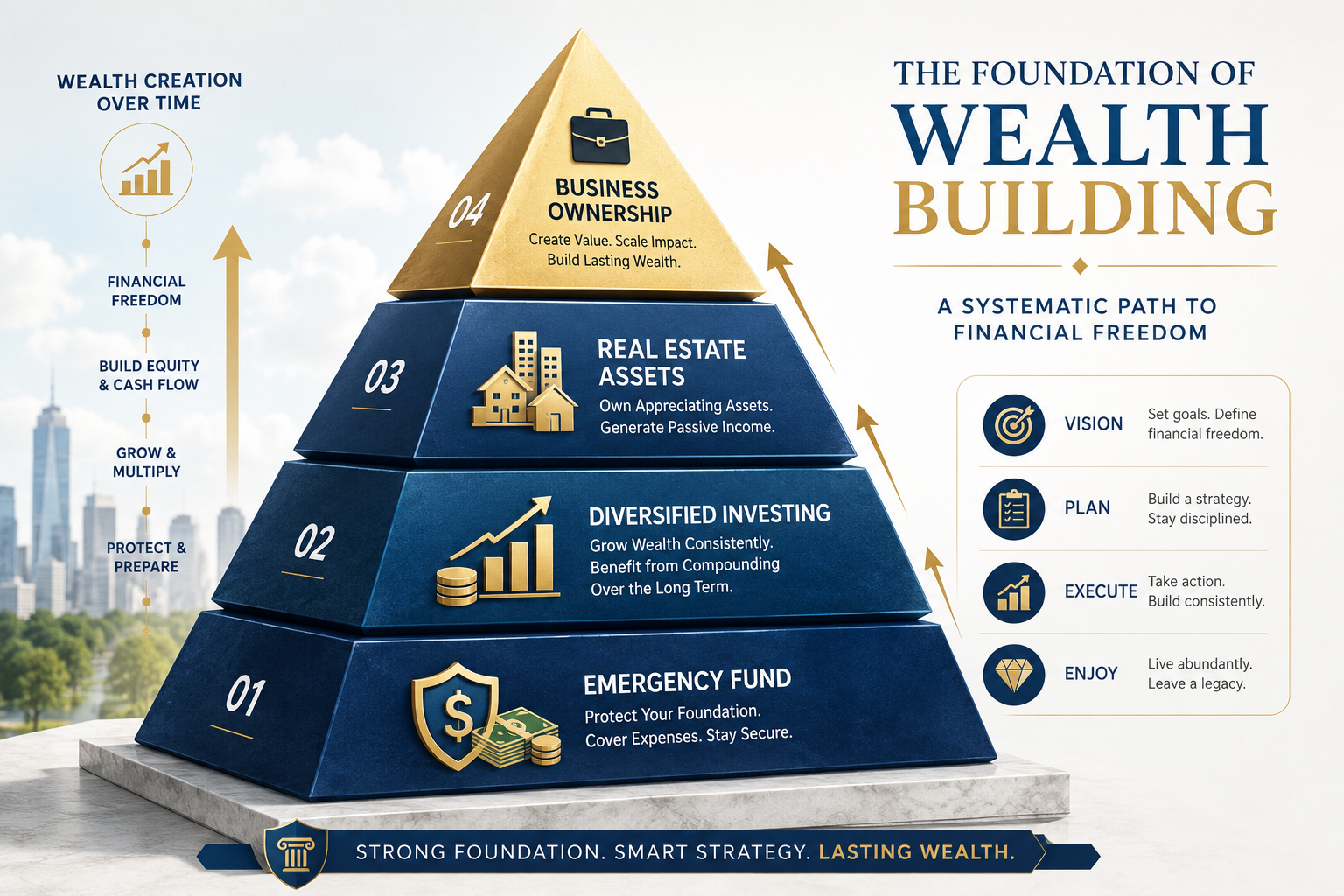
Key Takeaways
• Wealth building requires spending less than you earn and investing the difference in appreciating assets consistently over time
• Multiple income streams and strategic debt elimination accelerate wealth creation more than relying on salary increases alone
• Compound growth and time are the most powerful forces in building long-term financial freedom
• Financial education and disciplined habits matter more than perfect timing or market predictions
• Protecting wealth through insurance and estate planning is as important as creating it
What Does It Mean to Build Wealth?
Wealth represents ownership of assets that generate income or appreciate in value over time. Unlike earning a paycheck, which stops when work stops, wealth creates ongoing financial returns through investments, real estate, businesses, or other income-producing assets.
The fundamental difference between assets and liabilities determines financial success. Assets put money in your pocket—such as dividend-paying stocks, rental properties, or profitable businesses. Liabilities take money out of your pocket—including car payments, credit card debt, or expensive homes that drain monthly cash flow.
True financial freedom occurs when passive income from assets exceeds living expenses. This milestone means work becomes optional rather than necessary for survival. Building wealth requires systematically acquiring more assets while minimizing liabilities, allowing compound growth to work over decades.
Wealth building is a process, not an event. It demands consistent actions, smart decisions, and patience as small investments grow into substantial financial security. The strategies below provide a roadmap for this transformation.
15 Powerful Building Wealth Strategies
1. Spend Less Than You Earn
Why Financial Margin Matters
Creating a gap between income and expenses provides the foundation for all wealth-building activities. This financial margin enables saving for emergencies, investing in growth opportunities, and avoiding debt that destroys wealth over time.
Without spending discipline, even high earners struggle to build lasting wealth. Many professionals earning six-figure salaries live paycheck to paycheck because expenses consume their entire income. The size of the gap between earning and spending matters more than the absolute income amount.
Avoid Lifestyle Inflation
As income increases, the natural tendency involves upgrading lifestyle expenses proportionally. This lifestyle inflation prevents wealth accumulation by consuming additional earnings through larger homes, expensive cars, or luxury purchases.
Successful wealth builders maintain modest lifestyles even as income grows, directing extra money toward investments instead of consumption. They understand that today’s financial sacrifices create tomorrow’s financial freedom. Embracing an abundance mindset helps maintain this long-term perspective during tempting spending moments.
2. Build an Emergency Fund
Why Stability Comes First
An emergency fund prevents financial setbacks from becoming wealth-destroying disasters. Without this safety net, unexpected expenses force people to liquidate investments, accumulate high-interest debt, or miss investment opportunities during market downturns.
Emergency funds provide psychological peace of mind that enables better long-term financial decisions. Knowing that short-term problems won’t derail long-term plans reduces financial stress and prevents panic-driven choices that harm wealth building.
Recommended Savings Targets
Beginners should target $1,000 as an initial emergency fund while paying off high-interest debt. Once debt is eliminated, build the fund to cover 3-6 months of essential living expenses. Self-employed individuals or those in volatile industries may need 6-12 months of expenses saved.
Keep emergency funds in high-yield savings accounts or money market funds for easy access. While these accounts don’t generate significant returns, their purpose involves protection rather than growth. This foundation enables confident implementation of other building wealth strategies.
3. Invest Consistently Over Time
The Power of Compound Growth
Compound growth transforms modest regular investments into substantial wealth over decades. When investments generate returns, those returns generate additional returns, creating exponential rather than linear growth patterns.
Starting early provides enormous advantages due to compound growth. A 25-year-old investing $200 monthly at 7% annual returns will accumulate over $525,000 by age 65. Waiting until age 35 to start requires $400 monthly to reach the same result. Time amplifies the power of consistent investing more than any other factor.
Automate Investments
Automating monthly investments removes emotions and excuses from wealth building. Set up automatic transfers from checking accounts to investment accounts immediately after payday, treating investments like essential bills.
This approach ensures consistent investing regardless of market conditions, personal moods, or competing financial priorities. Dollar-cost averaging through automation reduces the impact of market volatility while building disciplined investment habits. Consider exploring techniques for financial manifestation to maintain motivation during this process.
4. Increase Your Income Strategically
Develop High-Income Skills
Focusing on skills that generate substantial income provides more resources for wealth building. High-income skills include sales, digital marketing, programming, financial analysis, project management, and specialized consulting.
These skills often transfer across industries and provide leverage for career advancement or freelance opportunities. Invest time and money in developing expertise that commands premium compensation rather than pursuing general skills with limited earning potential.
Create Multiple Income Streams
Diversifying income sources reduces financial risk while accelerating wealth accumulation. Multiple streams might include salary, freelance work, rental properties, dividend income, business profits, or digital product sales.
Start by leveraging existing skills for freelance income, then gradually build more passive income sources. Each additional stream provides security and compounds wealth-building potential. The goal involves creating income that doesn’t require trading time for money directly.
5. Eliminate High-Interest Debt
Why Debt Slows Wealth Creation
High-interest debt creates negative compound growth that works against wealth building. Credit card debt charging 18-24% annual interest requires investments earning higher returns just to break even—a difficult and risky proposition.
Debt payments also reduce available money for investing, creating opportunity costs that compound over time. Eliminating debt frees up monthly cash flow for wealth-building activities while removing the psychological burden of owing money.
Debt Payoff Strategies
The debt snowball method involves paying minimum amounts on all debts while directing extra payments toward the smallest balance first. This approach provides psychological wins that maintain motivation throughout the payoff process.
The debt avalanche method targets the highest interest rate debt first, minimizing total interest paid over time. Choose the approach that matches your personality and financial situation, but prioritize consistency over perfection in execution.
6. Invest in Index Funds and ETFs
Beginner-Friendly Investing
Index funds and ETFs provide simple, low-cost access to diversified investment portfolios. These funds track market indexes like the S&P 500, automatically providing exposure to hundreds or thousands of companies with a single purchase.
Low expense ratios (often under 0.1%) mean more money stays invested rather than paying management fees. This cost advantage compounds significantly over decades, potentially adding tens of thousands to final portfolio values.
Why Diversification Matters
Diversification reduces investment risk by spreading money across multiple companies, industries, and geographic regions. Individual stock picking requires extensive research and carries higher risk of permanent capital loss.
Broad market index funds capture overall economic growth without requiring predictions about specific companies or sectors. This approach has historically generated solid long-term returns while minimizing the risk of catastrophic losses that destroy wealth.
7. Buy Appreciating Assets
Real Estate
Real estate provides wealth building through appreciation, rental income, tax benefits, and inflation protection. Rental properties generate monthly cash flow while potentially appreciating in value over time.
Start with house hacking—buying a duplex, living in one unit, and renting the other to cover mortgage payments. This strategy provides real estate exposure with minimal out-of-pocket costs while building equity and rental income experience.
Businesses and Investments
Owning businesses or business interests creates wealth through profit distributions and asset appreciation. This might involve starting a company, buying franchise rights, or investing in private businesses through partnerships.
Business ownership provides more control over financial outcomes compared to traditional investments, but requires active management and carries higher risk. Balance business investments with passive investments for optimal risk management. Learn more about building wealth from nothing through smart choices.
8. Develop Financial Discipline
Delayed Gratification
Wealth building requires choosing long-term financial security over short-term consumption pleasures. This means driving older cars longer, living in modest homes, and avoiding expensive vacations while investments grow.
Practice delayed gratification in small ways to build this mental muscle. Wait 24 hours before making non-essential purchases, comparison shop for major expenses, and regularly review long-term financial goals to maintain motivation.
Emotional Control Around Money
Fear and greed drive poor financial decisions that harm wealth building. Fear causes selling investments during market downturns, while greed leads to speculative investments or lifestyle inflation.
Develop systems and rules for financial decisions rather than relying on emotions. Set investment allocation targets and rebalance periodically regardless of market conditions. Create spending budgets based on long-term goals rather than current desires.
9. Learn Financial Literacy
Understand How Money Works
Financial education provides the foundation for making informed wealth-building decisions. Learn about budgeting, investing, taxes, insurance, and estate planning through books, courses, and reputable online resources.
Understanding compound interest, risk management, asset allocation, and tax strategies enables optimization of wealth-building efforts. This knowledge prevents costly mistakes and identifies opportunities others might miss.
Read Books and Follow Trusted Experts
Continuously expand financial knowledge through books by proven experts like Warren Buffett, Jack Bogle, and Robert Kiyosaki. Follow reputable financial websites, podcasts, and newsletters for ongoing education.
Avoid get-rich-quick schemes or investment advice from unqualified sources. Focus on time-tested principles and strategies used by successful long-term investors rather than trendy approaches promising unrealistic returns.
10. Create Long-Term Financial Goals
Why Clear Goals Matter
Specific financial goals provide direction and motivation for wealth-building activities. Vague desires like “being rich” lack the clarity needed to guide daily financial decisions and measure progress.
Set SMART goals (Specific, Measurable, Achievable, Relevant, Time-bound) such as “accumulate $500,000 in investment accounts by age 50” or “generate $3,000 monthly passive income within 15 years.”
Examples of Wealth Goals
Common wealth-building goals include achieving financial independence by a specific age, accumulating enough assets to retire early, buying investment real estate, or creating passive income streams that cover living expenses.
Break large goals into smaller milestones to maintain motivation and track progress. Celebrate achievements along the way while adjusting strategies based on changing circumstances or new opportunities. Consider manifesting your future through specific tools and strategies to maintain focus on these goals.
11. Protect Your Wealth
Insurance and Risk Management
Insurance protects accumulated wealth from catastrophic losses that could destroy decades of financial progress. Health insurance prevents medical bankruptcies, while disability insurance replaces income if unable to work.
Life insurance provides financial security for dependents, and property insurance protects real estate investments. Adequate insurance coverage costs far less than potential losses from uninsured events.
Estate Planning
Estate planning ensures wealth transfers efficiently to intended beneficiaries while minimizing taxes and legal complications. Basic estate planning includes wills, beneficiary designations, and powers of attorney.
More complex estates may benefit from trusts, tax planning strategies, and business succession plans. Update estate planning documents regularly as wealth grows and family circumstances change.
12. Build Wealth Through Entrepreneurship
Starting a Side Business
Entrepreneurship provides unlimited income potential and valuable tax benefits compared to traditional employment. Start with low-cost online businesses that leverage existing skills and require minimal upfront investment.
Digital businesses like consulting, online courses, e-commerce, or content creation can scale without proportional increases in time investment. Focus on solving real problems for specific target markets rather than pursuing trendy business ideas.
Creating Scalable Income
Scalable businesses generate increasing revenue without proportional increases in time or effort. Digital products, software, rental properties, and franchises provide scalability that traditional service businesses lack.
Build systems and processes that enable growth without constant personal involvement. This approach creates true passive income that continues generating wealth even when not actively working.
13. Use Tax-Advantaged Accounts
Retirement Accounts
401(k), IRA, and Roth IRA accounts provide significant tax advantages for long-term investors. Traditional accounts offer immediate tax deductions, while Roth accounts provide tax-free withdrawals in retirement.
Maximize employer 401(k) matching contributions before investing in other accounts—this represents guaranteed 100% returns on invested money. Contribute consistently to retirement accounts throughout your career to benefit from decades of tax-advantaged growth.
Why Taxes Matter
Taxes significantly impact long-term wealth accumulation. A $10,000 investment growing at 7% annually becomes $76,123 after 30 years in a taxable account (assuming 22% tax rate), but grows to $101,073 in a tax-deferred account.
Understand the tax implications of different investment strategies and account types. Consider working with tax professionals to optimize strategies as wealth and complexity increase.
14. Surround Yourself With Financially Smart People
Environment Shapes Behavior
The people you spend time with influence financial attitudes and behaviors. Surround yourself with individuals who prioritize saving, investing, and building long-term wealth rather than those focused on consumption and lifestyle inflation.
Join investment clubs, attend financial seminars, or participate in online communities focused on wealth building. These environments provide motivation, accountability, and learning opportunities from others on similar journeys.
Avoid Toxic Financial Influences
Distance yourself from people who encourage overspending, mock frugal choices, or promote get-rich-quick schemes. Peer pressure toward expensive lifestyle choices can derail wealth-building progress.
Choose friends and advisors who support long-term financial goals rather than short-term gratification. This might mean declining expensive social activities or finding new social circles aligned with wealth-building priorities.
15. Stay Consistent for the Long Term
Wealth Rarely Happens Quickly
Building substantial wealth typically requires 20-40 years of consistent effort. Overnight success stories represent rare exceptions rather than normal outcomes, and often involve significant risks that could result in total loss.
Accept that wealth building is a marathon rather than a sprint. Focus on sustainable strategies that can be maintained for decades rather than aggressive approaches that lead to burnout or catastrophic losses.
Small Actions Compound Over Time
Daily financial habits seem insignificant individually but compound into substantial results over time. Saving $10 per day and investing it at 7% annual returns creates over $87,000 after 20 years.
Consistency matters more than perfection in wealth building. Regular small investments outperform sporadic large investments due to dollar-cost averaging and compound growth effects. Focus on systems and habits rather than dramatic gestures.
Common Mistakes That Prevent Wealth Building
Chasing Quick Riches
Get-rich-quick schemes, day trading, cryptocurrency speculation, and lottery tickets appeal to desires for instant wealth but rarely produce lasting results. These approaches often result in significant losses that set back legitimate wealth-building efforts.
Sustainable wealth building requires patience, discipline, and proven strategies rather than hoping for shortcuts. Focus on boring, consistent approaches that have worked for generations of successful investors.
Ignoring Investments
Keeping all money in savings accounts fails to keep pace with inflation over time. While savings accounts provide safety, they don’t generate the growth needed for long-term wealth accumulation.
Start investing even with small amounts to begin learning and benefiting from compound growth. The experience gained from investing $50 monthly provides valuable education for managing larger amounts later.
Overspending on Lifestyle
Trying to impress others through expensive purchases destroys wealth-building potential. Luxury cars, designer clothes, and expensive homes might provide temporary satisfaction but prevent accumulation of income-producing assets.
True wealth often remains invisible—wealthy individuals frequently drive modest cars and live in reasonable homes while accumulating substantial investment portfolios. Focus on net worth rather than appearances.
Waiting Too Long to Start
Procrastination costs enormous amounts due to lost compound growth opportunities. Waiting five years to begin investing can reduce final wealth by 30-50% even if larger amounts are invested later.
Start with whatever amount is available today rather than waiting for perfect conditions. Small beginnings grow into substantial wealth through time and consistency, while waiting often leads to never starting at all.
Building Wealth Strategies for Different Income Levels
Low Income
Focus on budgeting, eliminating debt, and developing higher-income skills. Even small amounts invested consistently can grow substantially over time through compound growth.
Prioritize emergency fund creation and high-interest debt elimination before investing. Look for free or low-cost education opportunities to develop skills that command higher compensation.
Middle Income
Increase savings rates and automate investments while avoiding lifestyle inflation. Middle-income earners often have the best wealth-building opportunities due to reasonable living costs and investment capacity.
Maximize retirement account contributions and consider real estate investments or side businesses to accelerate wealth accumulation. Focus on tax-efficient investing strategies.
Higher Income
Prioritize asset ownership, tax optimization, and estate planning. Higher earners face greater tax burdens but have more resources available for aggressive wealth-building strategies.
Consider business ownership, real estate investments, and tax-advantaged strategies like backdoor Roth conversions. Work with financial and tax professionals to optimize complex situations. Explore ways to generate wealth through smart investments for advanced strategies.
Signs Your Wealth Strategies Are Working
Growing Net Worth
Track net worth monthly by calculating total assets minus total liabilities. Consistent growth indicates effective wealth-building strategies, while declining net worth suggests needed adjustments.
Use apps or spreadsheets to monitor progress and identify trends. Focus on long-term direction rather than short-term fluctuations caused by market volatility.
Reduced Debt and Increasing Investments
Successful wealth building shows declining debt balances and growing investment accounts. The gap between assets and liabilities should widen consistently over time.
Lower Financial Stress
Effective wealth-building strategies reduce financial anxiety and provide greater confidence about the future. Emergency funds and growing investments create security that improves overall life quality.
Greater Financial Freedom and Flexibility
Accumulated wealth provides more choices and opportunities. This might include career changes, extended travel, or pursuing passions without financial pressure.
Simple Daily Habits That Support Wealth Building
Tracking Expenses helps identify spending patterns and opportunities for improvement. Use apps or simple spreadsheets to monitor where money goes each month.
Reviewing Financial Goals maintains focus and motivation during challenging periods. Spend a few minutes weekly reviewing progress and adjusting strategies as needed.
Learning About Investing through books, podcasts, or reputable websites builds knowledge that improves financial decisions over time.
Limiting Impulse Purchases by implementing waiting periods and questioning needs versus wants prevents unnecessary spending that reduces investment capacity.
Automating Savings ensures consistent progress toward wealth-building goals regardless of busy schedules or competing priorities.
Conclusion
Building lasting wealth requires implementing proven building wealth strategies consistently over decades rather than searching for shortcuts or perfect timing. The 15 strategies outlined above provide a comprehensive roadmap for achieving financial freedom through disciplined saving, smart investing, and long-term thinking.
Success comes from starting today with whatever resources are available, then maintaining consistency as circumstances improve. Whether beginning with $50 or $5,000, the principles remain the same: spend less than you earn, invest the difference in appreciating assets, and let compound growth work over time.
Focus on progress rather than perfection throughout this journey. Small improvements in spending habits, investment consistency, or income generation compound into substantial results over years. The key lies in taking action today while maintaining patience for long-term results.
Financial freedom becomes achievable for anyone willing to prioritize future security over present consumption. These building wealth strategies have created prosperity for millions of individuals—they can work for you too. Start implementing one strategy today, then gradually add others as habits develop and knowledge grows.
Remember that unlocking spiritual wealth often accompanies financial prosperity, creating a more fulfilling and balanced approach to abundance. Begin your wealth-building journey now, and let time and consistency transform your financial future.